The Boater's Glossary: Terms, Traditions & Myths
There's a moment every new boater dreads. You're untying from the dock, someone yells "cleat off the bow line," and you just... stand there. Smiling. Holding a rope. Hoping nobody notices you have no idea what a bow line is, let alone where to cleat it.
Good news: boat lingo isn't actually hard. It's just old, slightly weird, and never explained to you in plain English. So consider this your cheat sheet, the terms, the myths, and the lingo that'll have you sounding like you've been doing this for twenty years, even if today is day one.
Test Your Knowledge
Click the red plus icons to learn each boat term
Parts of the Boat (a.k.a. Things people will point at and assume you know)
Bow/Stern - Front and back. The bow is the pointy end that cuts through the water; the stern is where the wake kicks behind you. Easy way to remember: the bow goes first.
Forward/Aft - Toward the front or toward the back. Forward means in the direction of the bow; aft means in the direction of the stern. You'll hear these used as directions, "move forward" or "it's stored aft", rather than fixed locations. They're relative terms, which means they follow you around no matter where you're standing on the boat.
Port - Left. Most likely got its name from the practical reality of early ships. Ancient vessels were steered by a large oar mounted on the right side of the boat, which meant you couldn't dock on that side without damaging it. So ships always tied up with their left side against the port (dock). The loading and unloading side became the "port side," and the name stuck. Before "port" was standardized, the left side was actually called "larboard," which caused so much confusion with "starboard" when shouted across a noisy deck that the Royal Navy officially switched to "port" in 1844. Easy way to remember it: "port" and "left" both have four letters, that's the trick everyone uses, and it works.
Starboard - Right. It comes from the Old English stēorbord, stēor meaning "steer" and bord meaning "side of a boat." So starboard literally means the steering side, because that's where the steering oar was mounted on early Norse and Anglo-Saxon vessels. Sailors would stand on the left side to keep the steering oar in the water on the right, which also reinforced why docking happened on the left. The two words are essentially a matched pair, one side named for how you steered, the other for where you docked. Unlike port, there's no clean four-letter trick to fall back on, starboard you just have to commit to memory.
Helm - The word comes from the Old English helma, meaning rudder or tiller, the original steering mechanism before boats had wheels. Today it refers to the entire steering station: the wheel, throttle, and controls. So when you say "I'll take the helm," you're not just saying you'll drive, you're invoking about a thousand years of nautical history. Which does sound significantly cooler.
Transom — The flat vertical surface that forms the very back wall of the boat, closing off the stern. It's where you'll often find the engine mounted on smaller boats, along with boarding ladders, swim platforms, and rod holders. The word comes from the Latin transtrum, meaning crossbeam, which is exactly what it was on early wooden vessels. If someone says "hang it off the transom" or "step off the transom," now you know exactly where they mean.
Gunwale (pronounced "gunnel") — The upper edge or rail running along the top of the boat's sides, where the hull meets the deck. Originally it was the reinforced ledge where cannons were mounted on warships, "gun" plus "wale," an Old English word for a ridge or raised edge. On modern recreational boats there are no cannons involved, but the rail is still there and still useful for rigging, cleating lines, and giving passengers something to hold onto. Worth knowing how to say it correctly, "gunnel", before someone raises an eyebrow at you on the dock.
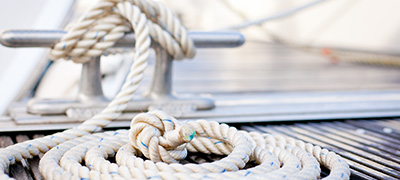
Cleat — The metal fitting, usually T- or horn-shaped, mounted on the dock or on your boat that you wrap lines around to secure everything in place. The figure-eight wrapping technique that locks a line to a cleat is one of the first practical skills every new boater should learn, it's the difference between a boat that stays put and one that doesn't. If you haven't learned it yet, it's covered in our Intro to Boating class.
Cockpit — The open area toward the stern of the boat where passengers sit and the helm is typically located, essentially the main operating and seating area of the boat.
Head - The bathroom. It comes from old sailing ships where the toilet was literally at the head (or bow) of the vessel, out in the open air, for obvious plumbing reasons. Glad we’ve upgraded since then, but the term stuck.
Galley - The kitchen. The word traces back to the ancient Mediterranean rowing ships called galleys, long, oar-powered vessels that dominated seafaring for centuries. On those ships, the cooking area was a defining enough feature that it took the ship's own name and stuck around long after those ships disappeared. So when you're making sandwiches in your boat's kitchen, you're using a word that's been at sea longer than pretty much anything else on board.
Beam - The widest point of the boat, measured side to side. The word comes from the Old English bēam, originally meaning a tree or thick piece of timber, which makes sense, since the beam was literally the main structural timber running across the width of early wooden vessels. Today, it's both a measurement and a reference point. Knowing your beam matters more than people realize, it's what determines whether you fit in a slip, clear a bridge fender, or squeeze through a narrow channel without having to hold your breath.
Hull - The body of the boat - everything below deck that actually touches the water.
Draft - How much of the boat sits below the waterline. Important when you’re eyeing a shallow inlet and don’t want to find out the hard way.
Maneuvers & Dock Talk
Cast off - Let go of the lines, we’re leaving
Clear off - Wrap a line around a cleat so it stays put.
Fenders out - Hang the fenders over the side before you dock. The fenders are the cushions that sit between your hull and the dock, and they're the only thing standing between your pristine gelcoat and an ugly scrape you'll be explaining for years. They’re one of the most important pieces of equipment on your boat.
Line, not rope - Once it’s on a boat and doing a job, rope becomes “line”. Sailors are very particular about this. Nobody fully agrees on why; everyone will correct you anyway.
Give-way Vessel: The boat that yields, or has to alter course
Stand-on vessel: Does not alter its course and is able to keep going
These two are very important to distinguish for boat safety and to prevent any mishaps on the water.
For example, you are the give-way vessel if another boat is approaching you on the right (or starboard!), you are overtaking another boat, or you are a power-driven vessel encountering a sailboat
You are the stand-on vessel if the other boat is approaching you on the left side (or port!) and should maintain your course without altering
Wake - The trail of disturbed water a boat leaves behind as it moves through the water. It can range from a gentle ripple at low speeds to a rolling wave that'll have your passengers grabbing for something to hold onto. It's also why "No Wake" signs exist; in marinas, narrow channels, and near shorelines, a large wake can damage docked boats, erode shorelines, and create dangerous conditions for smaller vessels. When you see a No Wake sign, slow down to the minimum speed needed to maintain steering. It's not just courtesy, in most areas it's the law.
Knots - Boat speed, measured in nautical miles per hour. A knot is about 1.15 regular miles per hour - so “going 20 knots” is faster than it sounds.
Boating Myths, Debunked
Not necessarily. Larger boats are often more stable and predictable in rough water than smaller ones, it's a different feel, not automatically a harder one. The best way to know what fits you is to actually get behind the wheel. That's exactly what a Demo Day at MarineMax is for.
For most recreational boating, you don't, though many states do require a boating safety education card, and requirements vary depending on where you'll be on the water. Worth checking your local rules before you head out. And if you do need to get certified, MarineMax offers the official U.S. Coast Guard–approved boating safety course at our store locations, so you can check the requirement off the list and actually feel confident doing it.
Sailboat skippers love this one, but it isn't true. When running on motor power, a sailboat is treated the same as any other powerboat. Give them space anyway, it's just good manners, but don't let anyone bully you off your course.
Lakes are smaller, sure, but smaller doesn't mean calmer. Waves in a lake have less room to travel, tend to stack up closer together, and bounce off the far shore, making for choppier, less predictable motion than you might expect. Respect the water regardless of what it's connected to.
The fastest racing boats on the water actually run two-blade props. More blades can reduce vibration, which is nice, but if speed is what you're after, the prop blade count isn't where to look.
This one has been around long enough that a lot of boaters treat it as fact. The belief is that a boat develops its own identity once named and christened, and the sea gods take note. If you absolutely must rename her, tradition calls for a full de-naming ceremony, write the old name on paper, burn it in a wooden box, and scatter the ashes overboard. Is it superstition? Yes. Is it a great story to tell your guests while you're doing it? Also yes. Either way, choose your name wisely the first time.
Technically yes, but probably not as far as you think. Standing on the deck of a small boat with your eyes about 6.5 feet above water, you can see roughly 2.5 miles to the horizon, not five or ten. Want more range? Get up to the flybridge. At 13 feet of elevation, you're looking at about 3.6 miles. Earth is curved and it will humble you.
Okay, this one is a real superstition with real staying power. The short version: in the 1700s, ships carrying bananas seemed to disappear at a disproportionate rate. Whether coincidence or not, the stigma stuck, and got layered with stories about spoilage, spiders, and toxic fumes from cargo holds. Is it a myth? Almost certainly. Will some captains still refuse to let you on their boat with a banana? Absolutely.
Compared to what? Think about what a week at a ski resort or a tropical resort actually costs, flights, hotels, rentals, meals. Boating's real costs often compare favorably, especially when you factor in that your "vacation" can happen on a Tuesday evening after work. MarineMax's finance team exists specifically to help people figure out what's actually possible for their budget.
This is the biggest one of all. Every confident captain was once standing on a dock holding a rope, smiling, having absolutely no idea what a bow line was. Classes like Intro to Boating and Women on Water® exist for exactly this reason, to shortcut the embarrassing part and get you straight to the fun part of enjoying every second on the water.
Find Your Perfect Boat Today
Brush Up Your Boating Skills